Artificial Intelligence is rapidly changing how organizations build products, deliver services, automate processes, and make business decisions. But as AI adoption accelerates, one question is becoming increasingly important:
Who is responsible for making sure AI is used safely, ethically, transparently, and in alignment with business objectives?
This is where ITIL® AI Governance (Version 5) becomes highly relevant.
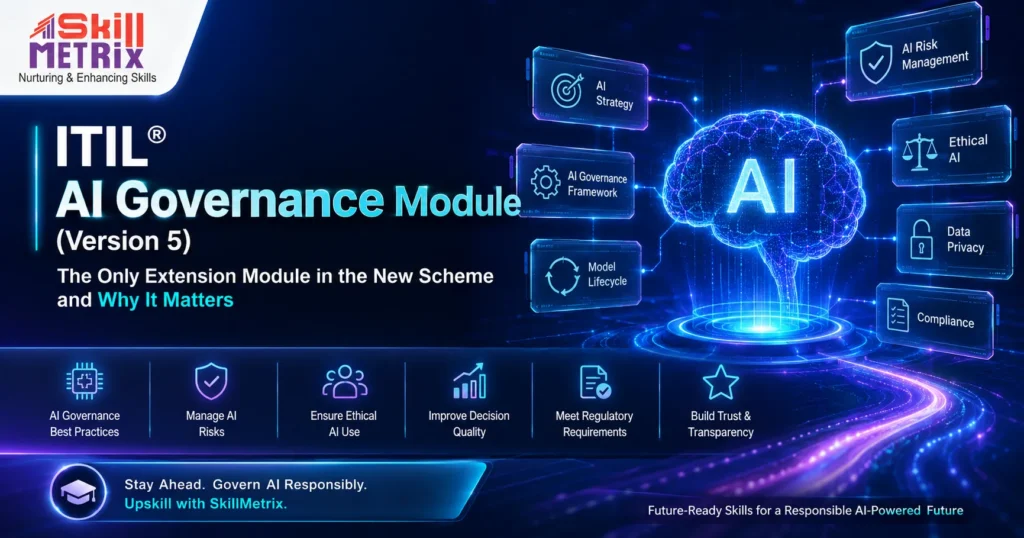
As part of the New ITIL® Version 5 qualification scheme, AI Governance is the only extension module. It was introduced to help organizations and professionals build practical capabilities to govern AI responsibly across digital products, services, operations, and organizational workflows.
For professionals working in IT service management, digital transformation, governance, risk, compliance, product management, and AI adoption, this makes ITIL AI Governance an important addition to their professional toolkit.
At SkillMetrix, we see this module as particularly relevant for professionals who want to move beyond simply understanding AI and develop the ability to govern AI effectively in real-world organizational environments.
What Is ITIL AI Governance (Version 5)?
ITIL AI Governance (Version 5) is an extension module within the New ITIL qualification scheme.
Unlike the core ITIL modules that form part of specific professional designations, AI Governance focuses specifically on the governance challenges created by the growing use of artificial intelligence.
According to PeopleCert, the module helps professionals build practical capability around oversight, accountability, transparency, ethical safeguards, risk management, and responsible AI adoption.
The objective is not simply to understand what AI is.
It is about answering questions such as:
These questions are becoming increasingly important as AI moves from experimentation into everyday business operations.
Why Is AI Governance Necessary?
AI can create enormous value.
Organizations are using AI for:
However, AI also introduces new risks.
An AI system can produce inaccurate information, expose sensitive data, create biased outcomes, make decisions that are difficult to explain, or operate outside the boundaries originally intended by the organization.
There is also the growing challenge of shadow AI, where employees use AI tools without formal organizational approval or governance.
Therefore, AI adoption cannot be treated purely as a technology implementation exercise.
It needs governance.
And this is exactly the space that ITIL AI Governance (Version 5) addresses.
ITIL Version 5 Makes AI Governance Explicit
One of the significant developments in the New ITIL Version 5 is the stronger focus on AI.
AI is not treated as something completely separate from service management. Instead, AI is increasingly connected with product management, service delivery, organizational governance, value creation, and transformation.
The ITIL Version 5 qualification scheme introduces AI Governance as the only extension module, while the other modules form the core qualification pathways.
This is an important distinction.
The module is not simply another optional IT course.
It represents ITIL’s recognition that organizations need dedicated capabilities for governing AI as AI becomes embedded in digital products, services, and business operations.
What Does the ITIL AI Governance Module Cover?
The module is designed around practical AI governance rather than AI technology alone.
Professionals can develop knowledge and skills in areas including:
1. ITIL, AI Governance and AI Fundamentals
The module establishes a foundation in ITIL, artificial intelligence, and governance.
This helps professionals understand AI within an organizational and service-management context rather than looking at AI purely from a technical perspective.
2. AI Benefits and Risks
AI adoption should not be driven simply by the desire to use the latest technology.
Organizations need to understand both the opportunities and potential consequences.
The module addresses the need to balance:
Innovation + Value + Trust + Accountability + Risk
This balance is critical when AI is being introduced into customer-facing services or business-critical processes.
3. Responsible AI Governance
Responsible AI requires more than a policy document.
Organizations need practical mechanisms for:
ITIL AI Governance helps professionals understand how these elements can be incorporated into organizational AI governance.
4. Applying the ITIL AI Capability Model
One of the important elements of the module is the ITIL AI Capability Model.
Professionals learn how to use the model to determine governance requirements and tailor risk profiles and controls according to different AI capabilities and use cases.
This is valuable because not every AI application carries the same level of risk.
An internal productivity assistant, an AI-powered service desk, and an AI system supporting critical business decisions may require very different governance approaches.
5. Applying the ITIL AI Governance Improvement Model
Governance should not be a one-time exercise.
AI capabilities, regulations, technologies, risks, and organizational requirements continue to evolve.
The module therefore introduces an AI Governance Improvement Model, helping organizations assess their current governance position, identify improvements, implement adjustments, and continue evaluating governance effectiveness.
ITIL AI Governance Is Different from Traditional AI Training
A common misconception is that learning AI governance means learning how artificial intelligence works technically.
That is not the primary purpose of this module.
AI technical training may teach you:
How to build or operate AI systems.
AI Governance focuses on:
How to ensure AI is being used responsibly and appropriately within an organization.
The distinction is important.
For example, an AI engineer may know how to develop a machine-learning model.
But an AI governance professional needs to consider:
This is where ITIL AI Governance provides a valuable organizational perspective.
Who Should Consider ITIL AI Governance (Version 5)?
The module is relevant to a broad range of professionals.
PeopleCert specifically positions it for professionals involved in AI governance and adoption, including those working across AI initiatives, product management, service management, operations, and organizational governance.
IT Service Management Professionals
ITSM professionals increasingly encounter AI-powered service desks, automation, knowledge management, predictive capabilities, and AI-assisted operations.
AI Governance can help them understand the governance implications of these technologies.
IT Leaders and Managers
Technology leaders are often responsible for deciding where and how AI should be adopted.
Understanding governance helps them balance business value with risk.
AI and Digital Transformation Professionals
Professionals involved in AI adoption and digital transformation can use governance principles to make AI initiatives more structured and sustainable.
Risk, Compliance and Governance Professionals
AI creates new governance challenges around accountability, transparency, privacy, risk, and responsible use.
The module can help governance professionals connect these challenges with an established service-management framework.
Product and Service Managers
AI is increasingly embedded into digital products and services.
Product and service professionals therefore need to understand how AI-related risks and controls can influence product and service decisions.
ITIL Professionals
For existing ITIL practitioners, AI Governance can be a logical way to expand their capabilities into one of the fastest-growing areas of modern IT management.
How Is AI Governance Connected to New ITIL Version 5?
The broader New ITIL Version 5 framework is designed for a digital and AI-enabled environment.
Its modules address areas such as:
The AI Governance module complements these areas by focusing specifically on how AI can be governed responsibly.
For example:
Product Management may focus on building and managing digital products.
Service Management focuses on delivering effective and resilient services.
Experience Management considers how people experience digital products and services.
Transformation addresses organizational change.
AI Governance provides a dedicated governance perspective for AI-enabled capabilities.
This creates an increasingly important connection between AI adoption and responsible value creation.
Why Is AI Governance Called an Extension Module?
The New ITIL Version 5 qualification structure distinguishes between core modules and extension modules.
PeopleCert confirms that AI Governance is the only extension module in the ITIL Version 5 qualification scheme. The previous ITIL 4 extension modules are no longer part of the Version 5 qualification scheme, with their content being absorbed into broader ITIL guidance and future learning offerings.
This makes AI Governance unique within the new scheme.
It is not designed as a mandatory component of every ITIL professional pathway.
Instead, it allows professionals and organizations with a specific interest in AI governance to develop focused expertise in this emerging area.
Why Does the ITIL AI Governance Module Matter Now?
The timing is particularly important.
AI adoption is moving rapidly from experimentation to operational use.
Organizations are asking:
“How can we use AI?”
But increasingly, leadership teams are also asking:
“How can we use AI responsibly?”
That second question is where governance becomes essential.
Without governance, AI initiatives can create:
Good AI governance does not necessarily mean slowing innovation.
Instead, it can provide the structure organizations need to scale AI with greater confidence.
AI Governance Should Not Be an Afterthought
One of the biggest mistakes organizations can make is implementing AI first and thinking about governance later.
A better approach is:
Governance by design.
Before deploying an AI capability, organizations should consider:
These questions help organizations move from uncontrolled AI experimentation toward structured AI adoption.
The Growing Importance of AI Governance Skills
AI skills are becoming valuable across industries.
But organizations increasingly need professionals who can connect AI capability with business governance.
This creates an emerging skill combination:
ITSM + AI + Governance + Risk + Business Value
Professionals who understand this intersection can become valuable contributors to AI-enabled transformation programs.
For IT professionals, this can also represent an opportunity to expand beyond traditional service management responsibilities.
Instead of only asking:
“Is the service working?”
Professionals may increasingly need to ask:
“Is the AI-enabled service working responsibly, securely, transparently, and in line with the organization’s objectives?”
That is a much broader responsibility.
Why Choose SkillMetrix for ITIL AI Governance Training?
At SkillMetrix, we understand that modern IT professionals need more than certification knowledge. They need practical understanding that can be connected to real organizational challenges.
Our focus is on helping professionals understand how emerging IT management practices can be applied in real-world environments.
With the introduction of ITIL AI Governance (Version 5), SkillMetrix provides professionals with an opportunity to explore the governance side of AI adoption while building on the globally recognized ITIL framework.
Whether you are an ITSM professional, service manager, IT leader, governance professional, product manager, transformation professional, or someone working closely with AI adoption, the ITIL AI Governance module can help you develop a more structured understanding of responsible AI governance.
Final Thoughts
Artificial Intelligence is no longer simply an emerging technology.
It is becoming part of how organizations design products, deliver services, engage customers, automate operations, and make decisions.
But AI adoption without appropriate governance can create significant risks.
This is why ITIL AI Governance (Version 5) matters.
As the only extension module in the New ITIL Version 5 qualification scheme, it provides a dedicated learning path for professionals who want to understand responsible AI governance and apply practical approaches to oversight, accountability, transparency, risk management, and continuous improvement.
For organizations, the message is simple:
AI adoption creates opportunity. AI governance creates confidence.
And for professionals, developing both capabilities can become an important differentiator in an increasingly AI-driven workplace.
If your organization is preparing for responsible AI adoption, or you are looking to strengthen your professional capabilities in AI governance, SkillMetrix can help you take the next step with ITIL AI Governance (Version 5) training and certification.
Ready to Build Responsible AI Governance Capabilities?
Explore ITIL AI Governance (Version 5) with SkillMetrix and learn how governance, accountability, risk management, and responsible AI adoption can work together to create sustainable business value.
