Managing a programme is very different from managing a single project.
A project usually focuses on delivering a defined outcome within agreed timelines, budgets, and scope. A programme brings together multiple related projects and activities to achieve broader organisational outcomes and strategic benefits.
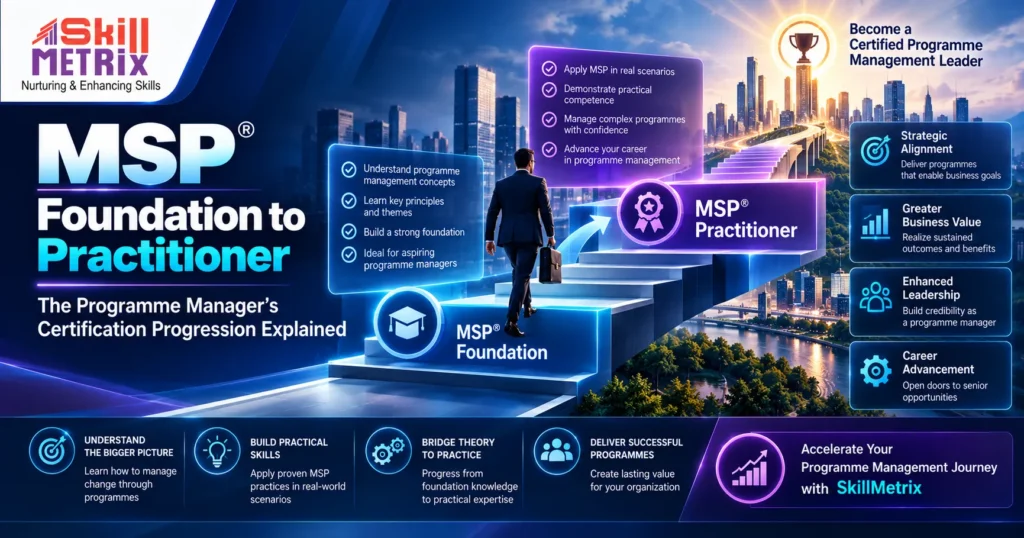
This is where MSP (Managing Successful Programmes) becomes relevant.
For professionals looking to build or strengthen their programme management career, the MSP Foundation to Practitioner certification path provides a structured way to develop knowledge first and then apply it in practical programme management situations.
At SkillMetrix, we help professionals understand not just the certification process, but also how MSP concepts can be applied to real-world programme environments.
What Is MSP?
MSP, or Managing Successful Programmes, is a programme management framework designed to help organisations manage coordinated programmes of change and deliver measurable outcomes and benefits.
While project management asks, “How do we deliver this project successfully?”, programme management looks at the bigger picture:
These questions make programme management particularly important for organisations going through digital transformation, business transformation, technology modernisation, regulatory change, or large-scale organisational change.
MSP Foundation: Building the Programme Management Base
The MSP Foundation certification is generally the starting point for professionals who want to understand the MSP approach.
At this stage, the objective is to develop a strong understanding of the framework, terminology, principles, processes, and key programme management concepts.
Foundation-level learning can help professionals understand areas such as:
For someone new to structured programme management, MSP Foundation provides the vocabulary and conceptual foundation required to understand how programmes are established and managed.
Who Can Benefit from MSP Foundation?
MSP Foundation can be relevant for a wide range of professionals, including:
At SkillMetrix, we recommend that professionals view Foundation as more than an examination milestone. It is an opportunity to understand how programme management differs from traditional project management.
What Comes After Foundation?
Once professionals have developed their Foundation-level understanding, the natural progression is towards MSP Practitioner.
This is where the learning becomes more application-oriented.
The transition from Foundation to Practitioner can be thought of as moving from:
“I understand the framework.”
to:
“I can apply the framework to programme management situations.”
That distinction is important for programme managers.
MSP Practitioner: Applying the Framework
The MSP Practitioner level focuses on applying MSP concepts in practical programme management scenarios.
Instead of simply knowing what a particular concept means, practitioners need to understand how it can be used when managing a real programme.
For example, imagine an organisation is implementing a major digital transformation involving:
Each initiative may have its own project manager, deliverables, timelines, and risks.
The programme manager needs to look beyond individual project delivery.
The bigger questions become:
Are all these initiatives contributing to the same strategic outcomes?
Are the expected benefits being realised?
Are dependencies between projects being managed?
Are stakeholders aligned?
Is the organisation actually adopting the change?
This is the type of broader thinking that programme management requires.
Foundation vs Practitioner: What Changes?
The progression can be understood simply:
| MSP Foundation | MSP Practitioner |
| Understand the MSP framework | Apply MSP concepts |
| Learn key terminology | Interpret programme scenarios |
| Understand principles and practices | Use them in practical situations |
| Build foundational knowledge | Develop application capability |
| Focus on “what” and “why” | Focus more on “how” |
The two levels therefore complement each other.
Foundation establishes the knowledge base, while Practitioner takes that knowledge into application.
Why Should a Project Manager Consider MSP?
Many experienced project managers eventually find themselves working on initiatives that extend beyond the boundaries of a single project.
A project manager may successfully deliver a technology implementation, but the organisation may still have to manage:
These are programme-level concerns.
Moving from project management into programme management therefore requires a shift in perspective.
Instead of focusing only on project outputs, programme managers need to focus on outcomes, benefits and organisational change.
MSP provides a structured way to develop this perspective.
The Foundation-to-Practitioner Journey
View the certification progression as a learning journey rather than two separate examinations.
Step 1: Understand the Programme Management Context
Before applying any framework, professionals should understand how a programme differs from a project.
A programme is generally concerned with coordinated change and the achievement of strategic outcomes and benefits.
Step 2: Build MSP Foundation Knowledge
The Foundation stage introduces the key concepts and structure of MSP.
Professionals become familiar with the framework and its terminology, creating a common language for programme management.
Step 3: Connect Concepts with Real-World Situations
The next step is to start thinking about how the concepts relate to actual programmes.
For example:
What happens when programme priorities change?
How should stakeholders be managed when their expectations conflict?
How can benefits be tracked across multiple projects?
How should programme-level risks be addressed?
This is where learning starts becoming practical.
Step 4: Progress to Practitioner
Practitioner-level learning focuses on applying MSP knowledge to programme management scenarios.
For professionals with project management experience, this stage can help bridge the gap between project delivery and broader programme leadership.
Step 5: Apply the Learning at Work
Certification becomes significantly more valuable when the knowledge is connected to workplace experience.
Professionals can look for opportunities to apply programme management thinking to:
MSP and Strategic Alignment
One of the important reasons organisations use structured programme management approaches is the need to connect change initiatives with organisational strategy.
A programme should not simply coordinate several projects because they happen to be related.
There should be a clear connection between the programme and the outcomes the organisation is trying to achieve.
For example, an organisation may have a strategic objective to improve customer experience.
A programme supporting this objective could include projects covering:
The programme manager’s role is not simply to monitor whether each project is delivering its assigned outputs.
The programme needs to remain focused on whether the combined change is contributing to the intended organisational outcomes and benefits.
Benefits Management: A Programme Manager’s Bigger Responsibility
One of the clearest differences between projects and programmes is the importance of benefits.
A project may deliver a new system successfully.
But delivering the system does not automatically mean the organisation has achieved the expected business benefit.
For example:
Project output: A new customer service platform is implemented.
Expected outcome: Customer service teams adopt the new platform and processes.
Potential benefit: Improved customer service performance and operational efficiency.
The programme perspective connects these elements.
This is why benefits management is such an important part of programme management thinking.
MSP for Digital Transformation Professionals
Digital transformation has made programme management increasingly relevant.
Large transformation initiatives often involve technology, people, processes, suppliers, governance and organisational change simultaneously.
A transformation programme may contain multiple projects that must work together.
For professionals working in:
MSP can provide a useful programme management perspective.
At SkillMetrix, we see strong relevance between programme management and today’s transformation environment, where organisations increasingly need professionals who can connect strategic objectives with coordinated change.
How SkillMetrix Can Support Your MSP Journey
At SkillMetrix, our focus is on helping professionals build practical knowledge that connects certification learning with workplace requirements.
Our training approach can support professionals who are looking to understand MSP concepts and progress through their certification journey.
SkillMetrix can help learners:
The objective at SkillMetrix is not simply to help professionals prepare for an examination. We aim to make the learning relevant to the situations professionals encounter in their organisations.
Who Should Consider the MSP Foundation-to-Practitioner Path?
This certification progression can be particularly relevant to professionals who want to develop their programme management capabilities, including:
Project Managers
Looking to move from individual project delivery towards managing coordinated programmes.
PMO Professionals
Who want to strengthen their understanding of programme governance, coordination and control.
Programme Coordinators
Looking to build structured programme management knowledge.
Transformation Managers
Working across multiple initiatives and organisational change activities.
Business Change Professionals
Who need to understand how organisational change connects with programme delivery.
IT and Digital Professionals
Managing large-scale transformation initiatives involving multiple projects and stakeholders.
Certification Is a Journey, Not the Destination
Moving from MSP Foundation to Practitioner should not be viewed simply as collecting another certification.
The real progression is in the way a professional think about change.
At Foundation level, the focus is on understanding the framework.
At Practitioner level, the focus moves towards applying that understanding.
With experience, professionals can then develop the ability to manage complex programmes involving multiple teams, projects, stakeholders, dependencies and organisational outcomes.
That progression can be represented as:
Foundation → Understand
Practitioner → Apply
Experience → Lead
For aspiring programme managers, this creates a structured pathway for developing both knowledge and practical capability.
Final Thoughts
Programme management is becoming increasingly important as organisations undertake larger and more complex transformation initiatives.
For professionals currently working in project management, PMO, business change, IT or transformation, MSP Foundation to Practitioner can provide a structured progression into programme management.
Foundation helps establish the knowledge base.
Practitioner builds the ability to apply that knowledge to programme scenarios.
The next step is using that learning in real organisational environments.
At SkillMetrix, we believe professional certifications are most valuable when they contribute to practical capability. We aim to help learners understand the why behind programme management, build their knowledge of MSP, and develop the confidence to apply structured approaches to real-world transformation.
If you are planning your next step from project management towards programme management, the MSP Foundation-to-Practitioner journey is worth exploring as part of your professional development.
Learn. Apply. Transform with SkillMetrix.
