In today’s fast-moving IT industry, organisations are under constant pressure to deliver faster, better, and more reliable services. At the same time, teams need to control costs, reduce delays, improve customer experience, and eliminate unnecessary work. This is where Lean Six Sigma can make a real difference.
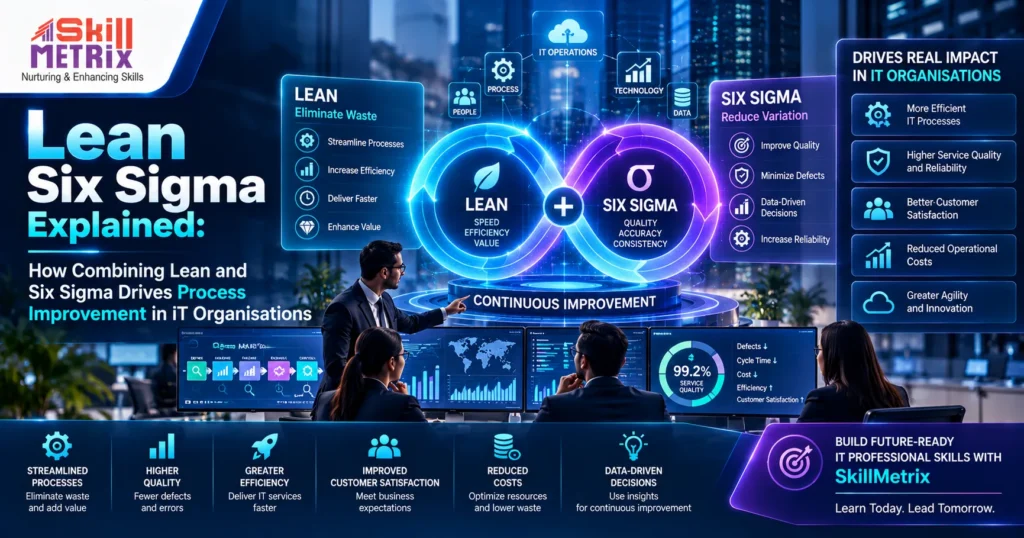
By combining Lean’s efficiency-focused approach with Six Sigma’s data-driven problem-solving methods, organisations can create more efficient, consistent, and customer-focused processes.
At SkillMetrix, we help professionals understand industry-relevant frameworks and methodologies that support continuous improvement, operational excellence, and better business outcomes.
What is Lean Six Sigma?
Lean Six Sigma brings together two complementary approaches.
Lean focuses on identifying and eliminating activities that do not add value to the customer. This could include unnecessary approvals, repetitive tasks, waiting time, excessive handovers, or inefficient workflows.
Six Sigma focuses on reducing variation, defects, and process inconsistencies by using data and structured problem-solving techniques.
Together, Lean Six Sigma provides a practical approach to answering two important questions:
Why Lean Six Sigma Matters in IT Organisations
IT organisations manage complex processes every day—from software development and testing to incident management, service requests, change management, and customer support.
Small inefficiencies can quickly become significant problems. For example, a service request may pass through multiple teams before reaching the customer, creating unnecessary waiting time. Similarly, repeated software defects can increase rework and delay releases.
Lean Six Sigma helps IT teams examine these processes systematically rather than relying on assumptions.
Some common benefits include:
Lean + Six Sigma: A Powerful Combination
Lean and Six Sigma are different, but they complement each other well.
Imagine an IT support process where resolving a ticket takes five days. A Lean approach may identify excessive handoffs and waiting periods as major sources of delay. Six Sigma techniques can then help analyse ticket data to identify recurring causes of errors or inconsistent resolution times.
The result is not simply a faster process—it is a better-controlled and more predictable process.
This combination makes Lean Six Sigma particularly useful for organisations looking to improve both efficiency and quality.
Lean Six Sigma in Real-World IT
Lean Six Sigma can be applied across different IT functions, including:
IT Service Management: Reducing incident resolution time and improving service request workflows.
Software Development: Identifying bottlenecks, reducing rework, and improving release processes.
IT Operations: Optimising operational workflows and reducing recurring issues.
Customer Support: Improving response times and reducing unnecessary escalations.
Project Management: Identifying delays, improving resource utilisation, and strengthening delivery processes.
How SkillMetrix Can Help
Understanding Lean Six Sigma is not just about learning terminology. Professionals need to understand how to apply its principles to real organisational challenges.
SkillMetrix supports professionals and organisations through practical, industry-focused learning programs designed to build relevant skills and improve professional capabilities.
Whether you are working in IT service management, project management, operations, or digital transformation, Lean Six Sigma can provide a structured way to identify problems, analyse their causes, and drive measurable improvements.
Final Thoughts
Lean Six Sigma is ultimately about creating processes that deliver more value with less waste and fewer errors. For IT organisations facing increasing demands for speed, quality, and customer satisfaction, this approach can become a valuable part of their continuous improvement journey.
With the right knowledge and practical application, Lean Six Sigma can help IT teams move from simply managing processes to continuously improving them.
Explore professional learning and certification opportunities with SkillMetrix to strengthen your knowledge of Lean Six Sigma and other globally relevant business and IT management practices.
