For years, IT service management focused heavily on processes, technologies, service availability, and operational efficiency. While these elements remain important, modern organizations have realized that success is no longer measured solely by uptime, service levels, or technical performance. Today’s customers judge organizations based on the quality of their overall experience.
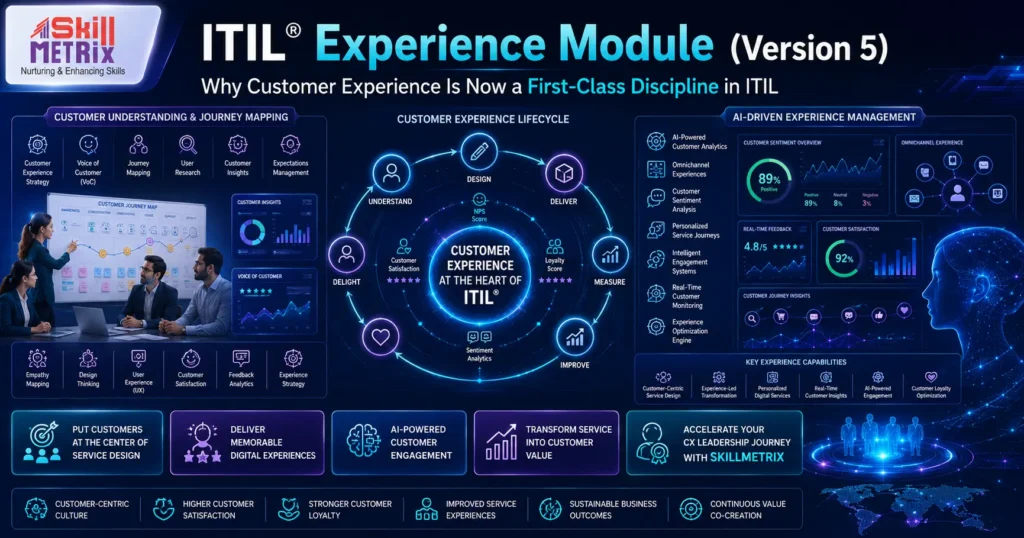
This shift is one of the most significant themes in ITIL® Version 5. The new ITIL Experience Module recognizes that customer experience (CX), employee experience (EX), and stakeholder perception are critical drivers of business value. Rather than treating experience as an outcome of good service management, ITIL Version 5 positions experience management as a discipline in its own right.
At SkillMetrix, we believe this evolution reflects the realities of the digital age, where organizations compete not only on products and services but also on the experiences they create. The ITIL Experience Module equips professionals with the knowledge and practices needed to design, manage, measure, and continuously improve experiences across the entire service ecosystem.
The Evolution of IT Service Management
Traditional ITSM frameworks often emphasized:
While these metrics remain valuable, they don’t always reflect how customers actually feel about the services they receive.
Consider a scenario where:
Yet the customer may still be frustrated due to poor communication, confusing interactions, or unmet expectations.
This is where experience management becomes essential.
The ITIL Experience Module acknowledges that perception often matters as much as performance. A technically successful service can still create a poor customer experience if human interactions and emotional responses are ignored.
Why Experience Has Become a Strategic Priority
Organizations across industries are increasingly investing in customer experience because it directly influences:
Customers who enjoy positive experiences are more likely to remain loyal, renew contracts, and recommend services to others.
In today’s connected world, customer feedback spreads quickly. A single negative experience can impact organizational reputation.
Research consistently shows that organizations delivering superior customer experiences outperform competitors in customer retention and revenue growth.
Happy employees create better customer experiences. The relationship between employee experience and customer satisfaction has become increasingly evident.
The ITIL Experience Module helps organizations understand these connections and integrate them into service management practices.
What Is the ITIL Experience Module?
The ITIL Experience Module is designed to help professionals understand how experiences are created, measured, managed, and improved throughout the service lifecycle.
The module focuses on:
Unlike traditional service management training, this module combines operational excellence with human-centered thinking.
At SkillMetrix, many professionals find this module particularly valuable because it bridges the gap between technical service management and business relationship management.
The Shift from Services to Experiences
One of the core messages of the ITIL Experience Module is that organizations no longer deliver only services—they deliver experiences.
A service experience includes:
Functional Elements
Human Elements
Emotional Elements
Together, these factors determine how customers evaluate a service.
The ITIL Experience Module teaches professionals how to manage all three dimensions rather than focusing exclusively on technical performance.
Understanding Experience Management
Experience management involves systematically designing and improving interactions between service providers and consumers.
Key principles include:
Human-Centered Design
Organizations should design services around human needs rather than internal processes.
Journey Thinking
Customers experience services through journeys, not isolated transactions.
Continuous Feedback
Experience management requires ongoing feedback collection and analysis.
Co-Creation of Value
Customers actively create value through their interactions with services.
These concepts align closely with ITIL’s Service Value System and value co-creation philosophy.
Customer Experience (CX) in ITIL Version 5
Customer experience has become a strategic business capability.
The ITIL Experience Module explores:
Customer Expectations
Understanding what customers truly value.
Moments That Matter
Identifying critical touchpoints that shape customer perception.
Experience Mapping
Visualizing customer journeys to identify pain points and improvement opportunities.
Personalization
Creating tailored experiences based on customer needs and preferences.
Trust Building
Developing long-term relationships through consistent service quality.
Professionals trained through SkillMetrix’s ITIL Version 5 programs learn practical techniques to improve customer experience across both digital and traditional service environments.
Employee Experience Matters Too
Great customer experiences rarely happen without engaged employees.
The ITIL Experience Module recognizes that employee experience significantly influences:
Organizations that invest in employee experience often achieve better customer outcomes.
This perspective represents a major advancement in service management thinking.
Measuring Experience Effectively
Traditional IT metrics alone cannot capture experience quality.
The ITIL Experience Module introduces a broader measurement framework that may include:
Customer Satisfaction (CSAT)
Measures customer satisfaction with specific interactions.
Net Promoter Score (NPS)
Assesses customer loyalty and willingness to recommend.
Customer Effort Score (CES)
Evaluates how easy it is for customers to achieve desired outcomes.
Sentiment Analysis
Analyzes customer emotions and perceptions.
Employee Experience Metrics
Measures engagement and workplace satisfaction.
At SkillMetrix, we emphasize the importance of balancing operational metrics with experience-focused indicators to gain a complete view of service performance.
Experience and Digital Transformation
Digital transformation initiatives often focus on technology implementation.
However, successful transformation requires:
Many digital transformation projects fail not because of technology limitations but because they overlook the human experience.
The ITIL Experience Module helps professionals ensure that technology investments translate into meaningful business outcomes and positive experiences.
Key Benefits of the ITIL Experience Module
Professionals who complete the ITIL Experience Module gain the ability to:
Improve Customer Satisfaction
Design services that better meet customer expectations.
Enhance Service Relationships
Build stronger partnerships with stakeholders.
Increase Business Value
Align service management activities with organizational objectives.
Support Digital Transformation
Create people-centric digital experiences.
Drive Continuous Improvement
Use feedback and analytics to improve experiences over time.
Strengthen Leadership Capabilities
Develop strategic thinking around customer and employee engagement.
These skills are becoming increasingly valuable across industries and organizational roles.
Who Should Take the ITIL Experience Module?
This module is particularly beneficial for:
Many professionals attending SkillMetrix ITIL training programs find that the Experience Module provides practical knowledge that can be immediately applied in customer-facing and service management roles.
Why Learn ITIL Version 5 with SkillMetrix?
As organizations increasingly prioritize experience management, choosing the right training partner becomes essential.
SkillMetrix offers expert-led ITIL Version 5 training programs designed to help professionals understand not only the theory but also the practical application of modern service management concepts.
When learning with SkillMetrix, participants benefit from:
Whether you are advancing your ITSM career or leading organizational transformation initiatives, SkillMetrix provides the knowledge and support needed to succeed in today’s experience-driven economy.
Conclusion
The ITIL Experience Module represents one of the most important advancements in modern service management. It recognizes that exceptional services are no longer defined solely by technical performance but by the experiences they create for customers, employees, and stakeholders.
As organizations continue their digital transformation journeys, experience management will become an increasingly critical capability. Professionals who understand how to design, measure, and improve experiences will be well-positioned to lead the next generation of service excellence.
Through its focus on human-centered service management, the ITIL Experience Module helps organizations move beyond service delivery toward experience-driven value creation.
For professionals seeking to master these emerging capabilities, SkillMetrix continues to provide industry-leading ITIL Version 5 training and guidance, helping individuals and organizations build the skills required for the future of service management.
