In today’s fast-moving digital world, organizations are expected to release applications and services quickly. Development teams are under pressure to deliver new features, operations teams need deployments to run smoothly, and customers expect digital experiences that are both seamless and secure.
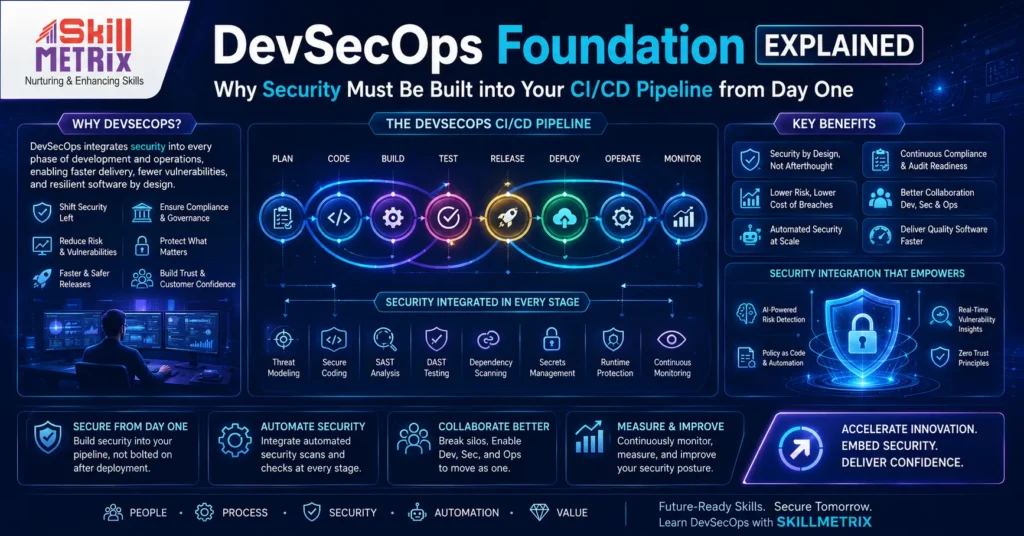
That last expectation is especially important. Security cannot be something teams check only at the end of a project. By then, fixing a vulnerability may be costly, disruptive, and stressful for everyone involved.
This is where DevSecOps makes a real difference.
DevSecOps brings development, security, and operations together. It encourages teams to consider security throughout the software development and delivery lifecycle—not just when an application is ready for production.
For professionals who want to understand this approach, DevSecOps Foundation offers a practical starting point. At SkillMetrix, we help IT professionals and organizations build knowledge that reflects the way technology teams work today.
What Is DevSecOps?
DevSecOps stands for Development, Security, and Operations.
It builds on the DevOps philosophy by making security a shared responsibility across the entire software lifecycle.
In a traditional environment, the process may look something like this:
Develop → Test → Deploy → Security Check
The challenge is that security testing often happens late. If a vulnerability is discovered just before release—or after the application is already live—the team may need to delay the launch, rework the code, or respond to a serious security incident.
DevSecOps takes a more integrated approach:
Plan → Code → Build → Test → Secure → Release → Deploy → Monitor
Security is considered at every stage.
The goal is not to create unnecessary checks or slow teams down. It is to make secure development part of the normal way software is planned, built, tested, deployed, and maintained.
Why Does Security Need to Be Built in from Day One?
Security issues are usually easier and less expensive to fix when they are found early.
Consider a team developing a customer-facing application. During coding, a developer unintentionally introduces an insecure practice. If the issue is identified immediately, it can often be corrected with minimal disruption.
If the same issue is discovered after the application goes live, the situation becomes much more complicated. The organization may need to:
No team wants to deal with that level of disruption if it can be avoided.
Finding and addressing security issues early gives teams more time, more options, and greater control. This is one of the central ideas behind DevSecOps.
What Is the Role of CI/CD in DevSecOps?
CI/CD—Continuous Integration and Continuous Delivery/Deployment—is central to modern software delivery.
A CI/CD pipeline automates many of the steps involved in moving code from development into production. A simplified pipeline might look like this:
Code → Build → Test → Security Scan → Package → Deploy → Monitor
DevSecOps adds security controls to this flow without treating security as a separate, disconnected activity.
Security checks can be introduced at several points:
1. Source Code Management
Developers can use secure coding practices and automated tools to identify potentially vulnerable code before it moves further through the pipeline.
2. Dependency Management
Most modern applications rely on open-source libraries and third-party components. These dependencies can create risks if they contain known vulnerabilities.
Automated dependency scanning helps teams identify outdated or unsafe components before they become a larger problem.
3. Build Stage
Security checks can be included in the build process to detect issues in code, packages, and artifacts before they progress to later stages.
4. Testing
Security testing can be included alongside functional and performance testing. This gives the team faster feedback and reduces the chance of discovering major issues just before release.
5. Deployment
Infrastructure configurations, containers, cloud resources, and deployment settings can all introduce security risks. These should be reviewed and tested as part of the deployment process.
6. Production Monitoring
DevSecOps does not end when an application is deployed.
Continuous monitoring helps teams identify suspicious activity, unusual behaviour, vulnerabilities, and emerging threats in the live environment.
The Shift from “Security Team Responsibility” to “Shared Responsibility”
One of the most important changes DevSecOps brings is cultural.
In a traditional environment, a developer might say:
“Security is the security team’s responsibility.”
DevSecOps encourages a different mind-set.
Security becomes a shared responsibility.
Developers need to understand secure coding practices. Operations teams need to consider secure infrastructure and deployment. Security professionals need to understand development workflows, automation, and delivery pressures.
Managers and leaders also have an important role. They need to set clear security expectations, support collaboration, and make sure teams have the time and resources to address risks properly.
This shared approach helps reduce the gaps that often appear when teams work in isolation.
Understanding the DevSecOps “Shift Left” Approach
You will often hear the phrase Shift Left when discussing DevSecOps.
The idea is simple: bring security activities earlier into the software lifecycle.
Instead of waiting until the end:
Develop → Deploy → Security Testing → Fix
Teams aim to work more like this:
Plan → Develop Securely → Test → Scan → Fix → Deploy
When an issue is found early, it is usually easier for the team to understand, correct, and retest.
However, Shift Left does not mean security only happens during development. A mature DevSecOps approach combines early security practices with continuous security throughout the lifecycle.
Security needs to be considered during planning, development, deployment, operations, and incident response.
Key Practices in DevSecOps
DevSecOps Foundation introduces professionals to several practices that help bring security into DevOps environments.
Some of the most important include:
Secure Coding
Developers learn to recognize and prevent common security weaknesses while writing code. This helps reduce the number of vulnerabilities that reach later stages of the pipeline.
Automated Security Testing
Security testing can be integrated into automated workflows so teams receive feedback quickly and consistently.
Vulnerability Management
Organizations need a clear process for identifying, assessing, prioritizing, and remediating vulnerabilities. Not every issue has the same level of risk, so prioritization matters.
Infrastructure as Code Security
Infrastructure configurations can create security problems just as application code can. Security checks can be applied to Infrastructure as Code before it is deployed.
Container Security
Containers are widely used in modern application environments. Container images, dependencies, permissions, and configurations should be assessed for potential vulnerabilities.
Secrets Management
Passwords, API keys, certificates, and other sensitive credentials should never be stored carelessly in source code or exposed through insecure configuration files.
Continuous Monitoring
Security does not end after deployment. Continuous monitoring helps teams detect emerging threats, unusual behaviour, and changes in the risk environment.
DevSecOps and Automation
Automation is one of the main reasons DevSecOps can work at scale.
Without automation, security teams may struggle to keep up with organizations that release software frequently—sometimes several times a day.
If every deployment requires a completely manual security review, the process can quickly become a bottleneck. Automated controls help teams perform routine checks consistently and provide feedback earlier.
A pipeline might look like this:
Developer commits code
↓
Automated build
↓
Unit testing
↓
Code quality analysis
↓
Security scanning
↓
Dependency scanning
↓
Application testing
↓
Deployment approval
↓
Production deployment
↓
Continuous monitoring
Automation does not remove the need for human judgment. Instead, it handles repeatable checks so security professionals and delivery teams can focus their attention on complex risks and important decisions.
Why DevSecOps Matters for Modern Organizations
Organizations today operate in increasingly complex environments that include:
These technologies create exciting opportunities, but they also introduce new risks.
A security model based mainly on occasional assessments may not be enough for an organization that releases software continuously. By the time a periodic review takes place, the application, infrastructure, or threat landscape may have changed significantly.
DevSecOps helps organizations connect security with the speed, flexibility, and automation of modern software delivery.
DevSecOps Foundation: What Professionals Can Learn
The DevSecOps Foundation approach is valuable for professionals who want to understand how security fits into a modern DevOps environment.
This knowledge can benefit:
The purpose is not to turn every developer into a cybersecurity specialist or expect every security professional to become a full-time developer.
Instead, DevSecOps helps people understand how their work affects the security of the wider software delivery lifecycle.
That shared understanding can improve communication, reduce delays, and help teams make better decisions.
DevSecOps vs Traditional Security
The difference can be summarized simply:
| Traditional Approach | DevSecOps Approach |
| Security often happens late | Security starts early |
| Security team-centric | Shared responsibility |
| Manual checks | Automated controls where possible |
| Periodic testing | Continuous testing and monitoring |
| Security can become a release bottleneck | Security integrated into the delivery flow |
| Vulnerabilities are fixed near the end | Issues are identified and fixed earlier |
| Separate security processes | Security integrated with CI/CD |
DevSecOps is not about removing traditional security practices. Those practices still have an important role.
Instead, DevSecOps complements them by embedding security into everyday development and delivery activities.
DevSecOps Is More Than Tools
A common misconception is that implementing DevSecOps simply means purchasing security tools and adding them to a CI/CD pipeline.
Tools are useful, but they are only part of the solution.
Successful DevSecOps depends on three connected elements:
People
Teams need the right knowledge, communication, collaboration, and security mindset.
Process
Security practices need to be built into development, testing, deployment, and operational workflows.
Technology
Automation and security tools help teams apply controls consistently and at scale.
If the culture and processes are not in place, adding more tools may simply create more alerts, more confusion, and more work. DevSecOps succeeds when people, processes, and technology support one another.
What Does a Secure CI/CD Pipeline Look Like?
A secure CI/CD pipeline may include controls such as:
Plan
→ Identify security requirements, risks, and compliance needs
Code
→ Apply secure coding practices and protect sensitive information
Build
→ Check dependencies, packages, and artifacts
Test
→ Perform automated security and application testing
Release
→ Validate security and compliance requirements
Deploy
→ Apply secure infrastructure and configuration practices
Operate
→ Monitor systems and applications
Respond
→ Detect, investigate, and remediate security issues
Together, these activities create a continuous security feedback loop.
The pipeline is not just moving code from one stage to another. It is also helping the organization learn, respond, and improve with every release.
Why DevSecOps Skills Matter for IT Professionals
Technology is moving toward faster, more automated delivery models.
Professionals who understand only their own function may find it increasingly difficult to see how their decisions affect the wider environment.
A developer needs to understand how code can affect production security.
An operations professional needs to understand how infrastructure choices can create application risks.
A security professional needs to understand CI/CD, automation, and the realities of modern development.
A manager needs to understand how security requirements influence delivery speed, risk, cost, and business outcomes.
DevSecOps helps create this shared understanding. It gives teams a common language and encourages them to solve security challenges together rather than passing responsibility from one group to another.
How SkillMetrix Can Help
At SkillMetrix, we understand that modern IT professionals need more than theoretical knowledge. They need to see how frameworks, methodologies, and best practices apply to real technology environments.
Our certification and training portfolio covers a range of modern IT and digital practices, helping professionals strengthen their knowledge and stay aligned with changing industry expectations.
For professionals interested in DevSecOps, DevSecOps Foundation can be a valuable step toward understanding how development, operations, security, automation, and continuous delivery work together.
Whether you are a DevOps professional looking to strengthen your security knowledge, a security professional moving into an automated delivery environment, or an IT leader supporting digital transformation, DevSecOps knowledge can help you make more informed decisions.
At SkillMetrix, our goal is to support professionals as they build practical, relevant skills for today’s evolving IT landscape.
Final Thoughts
Organizations are expected to release software faster than ever, but speed should not come at the expense of security.
Security cannot remain a final checkpoint that happens just before release. It needs to become part of the process from the beginning.
DevSecOps brings security into the CI/CD pipeline early and continuously—helping organizations identify risks sooner, automate security controls, improve collaboration, and build safer software.
The message is simple:
Don’t secure software only after you build it. Build it securely from the start.
For professionals who want a structured introduction to this approach, DevSecOps Foundation provides a strong foundation for understanding the relationship between development, security, and operations.
With SkillMetrix, professionals can explore certification-focused learning opportunities designed to support their growth in today’s rapidly changing IT environment.
Ready to strengthen your DevSecOps knowledge?
Explore DevSecOps Foundation training and certification opportunities with SkillMetrix, and take the next step toward building security into modern software delivery.
