Every organization runs more projects than it can actually deliver well. Budgets get stretched, priorities compete for the same people, and somewhere in the mix, a project that has nothing to do with this year’s strategy keeps chugging along simply because nobody stopped to ask why it’s still funded.
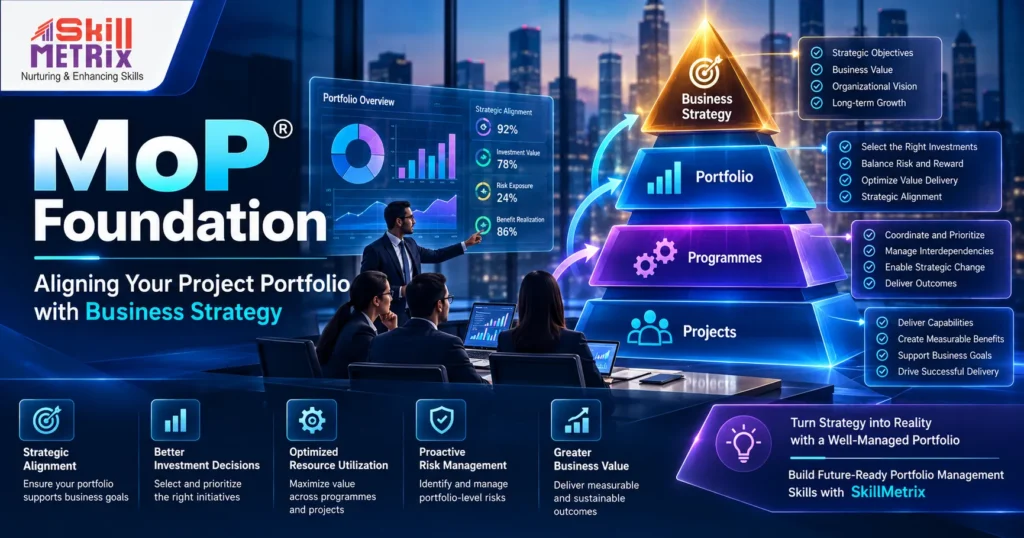
This is the exact problem that Management of Portfolios (MoP) was built to solve. And it’s why the MoP Foundation certification has become such a practical starting point for anyone responsible for deciding what an organization should — and shouldn’t — be investing in.
At SkillMetrix, we work with project and programme managers, PMO leads, and senior IT stakeholders every week who are trying to make sense of exactly this challenge. So let’s break down what MoP actually is, why “alignment with strategy” is harder than it sounds, and how the Foundation certification helps.
What MoP Actually Means
Management of Portfolios is a best-practice framework, developed under the AXELOS/PeopleCert umbrella, for selecting and managing the right mix of projects and programmes across an organization. Where PRINCE2® focuses on running a single project well, and MSP focuses on programmes, MoP zooms out further — to the entire collection of change initiatives an organization is funding at once.
The core idea is simple to say and genuinely difficult to do: make sure every project in the portfolio earns its place by contributing to business strategy, and be willing to stop funding the ones that don’t.
Why Alignment Breaks Down in Practice
Most organizations don’t lack strategy documents. They lack a reliable way to connect those documents to the hundred smaller decisions made every month about which projects get resources.
A few patterns show up again and again:
MoP gives structure to fix each of these — not through more paperwork, but through a defined set of principles, a cycle for managing the portfolio, and practical techniques for prioritization and categorization.
The Five MoP Principles
MoP rests on five principles that, together, keep the portfolio honest:
That last one is worth sitting with. A portfolio that only ever adds projects and never retires any isn’t really being managed — it’s just accumulating.
Two Cycles, Working Together
MoP organizes work into two connected cycles:
Definition without delivery just produces a well-organized wish list. Delivery without definition means executing efficiently on the wrong things. MoP insists on both.
Who Benefits from MoP Foundation
The MoP Foundation certification is aimed at anyone who influences what an organization chooses to invest in and deliver — PMO managers and analysts, portfolio and programme managers, business change managers, and senior executives who sit on investment or steering committees. It’s equally valuable to project managers who want to understand the bigger picture their individual projects sit inside.
For IT-heavy organizations in particular, where change initiatives, infrastructure upgrades, and digital transformation projects often multiply faster than governance can keep up, MoP Foundation gives a shared vocabulary and a shared discipline for portfolio decisions.
Why Learn MoP with SkillMetrix
At SkillMetrix, MoP Foundation is one of the certifications we get asked about most by organizations trying to bring order to a sprawling project landscape. Our training is built to be practical rather than theoretical — real prioritization exercises, real categorization models, and real conversations about why portfolios drift from strategy in the first place.
SkillMetrix trainers bring hands-on PMO and programme experience into the classroom, so the framework doesn’t stay abstract. And because SkillMetrix sits within the broader PeopleCert training ecosystem alongside PRINCE2®, MSP, and MoR/MoR®, learners often find that MoP Foundation connects naturally with certifications they’ve already completed or plan to pursue next.
If your organization is funding more projects than it can strategically justify, MoP Foundation is a strong place to start. Contact the SkillMetrix team to learn about upcoming batches, corporate training options, and how MoP fits into a broader PeopleCert learning path.
