Most organizations today are managing more than one major change initiative at a time. Digital transformation, business restructuring, technology upgrades, new product launches, regulatory changes, and process improvement often involve several projects working toward one larger goal.
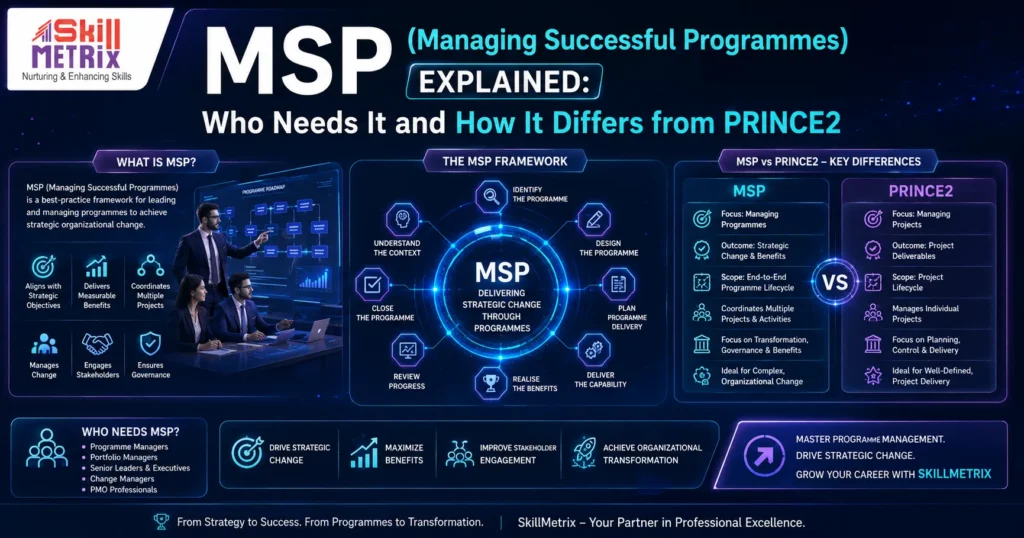
That is where MSP (Managing Successful Programmes) can make a real difference.
Project management focuses on delivering a specific project successfully. Programme management takes a wider view. It brings related projects together, manages their connections, and ensures they contribute to meaningful business outcomes.
For professionals working in project management, programme management, PMO, transformation, or business change, understanding the difference between MSP and PRINCE2 is important. Both offer structured ways to manage change, but they address different needs.
At SkillMetrix, we help professionals understand globally recognized project, programme, and service management frameworks in a practical, real-world context. In this article, we’ll look at what MSP is, who can benefit from it, and how it differs from PRINCE2.
What Is MSP?
MSP, or Managing Successful Programmes, is a structured programme management framework that helps organizations manage complex programmes and achieve strategic outcomes.
A programme usually brings together several related projects and activities. They are managed as one coordinated effort because they support a shared business objective.
For example, imagine an organization starting a large digital transformation programme. It might include:
Each project may have its own goals, budget, timeline, and team. However, completing all of them individually does not automatically mean the organization has achieved its larger objective.
The programme must connect the work, manage dependencies, support people through change, track benefits, and make sure the overall investment is delivering value.
That is where MSP comes in.
Why Is Programme Management Important?
Projects are usually temporary initiatives created to deliver specific outputs.
Programmes focus on something broader: coordinating change and achieving outcomes and benefits.
Consider a company introducing a new enterprise-wide technology platform. The project may successfully deliver and launch the system, but that is only part of the story.
What happens next?
These questions go beyond project delivery.
Programme management helps connect individual projects to the organization’s strategy and ensures that the intended benefits are not lost along the way. This is one of the main reasons organizations use frameworks such as MSP.
Who Needs MSP?
MSP is especially useful for professionals involved in large-scale change, transformation, strategic initiatives, or multiple connected projects.
1. Programme Managers
Programme managers are responsible for coordinating several projects and keeping the overall programme aligned with organizational goals.
MSP gives them a structured way to think about governance, decision-making, dependencies, risks, stakeholders, outcomes, and benefits.
2. Project Managers Moving into Programme Management
Managing one project and managing a programme are very different experiences.
A project manager moving into programme management must begin looking beyond a single schedule or set of deliverables. They need to consider:
MSP can provide a helpful foundation for making that transition with greater confidence.
3. PMO Professionals
PMOs often support project and programme governance across an organization.
Professionals working in PMO roles can benefit from understanding how programmes are structured, governed, monitored, and connected to business strategy.
MSP knowledge can also complement existing project management qualifications and PMO experience.
4. Transformation Professionals
Digital transformation rarely involves just one project. It often brings together technology, people, processes, communications, governance, and organizational change.
Transformation leaders need to coordinate all these moving parts while keeping everyone focused on the same business objective. MSP provides a programme-level perspective that can help them manage this complexity.
5. Senior Managers and Business Leaders
MSP is not only for programme managers.
Senior leaders involved in strategic change often sponsor programmes, approve investments, set priorities, monitor benefits, and make important decisions.
Understanding programme management can help them ask better questions, identify risks earlier, and make more informed decisions about organizational change.
6. Professionals Managing Organizational Change
Whenever several projects contribute to a broader transformation, programme management can be valuable.
Examples include:
MSP vs PRINCE2: What Is the Difference?
One question we often hear is:
“If I already know PRINCE2, why do I need MSP?”
The answer is that PRINCE2 and MSP operate at different management levels.
PRINCE2 is primarily a project management method, while MSP is a programme management framework.
A simple way to think about it is:
PRINCE2 helps you manage an individual project. MSP helps you coordinate multiple related projects and change initiatives to achieve broader outcomes and benefits.
Here is a quick comparison:
| Area | PRINCE2 | MSP |
| Primary focus | Project management | Programme management |
| Main objective | Deliver project outputs | Achieve programme outcomes and benefits |
| Scope | Individual project | Multiple related projects and activities |
| Focus | Outputs and project objectives | Outcomes, benefits, and strategic alignment |
| Timescale | Usually the project lifecycle | Often broader and longer-term |
| Dependencies | Project-level dependencies | Cross-project and programme dependencies |
| Change | Controlled project change | Coordinated organizational change |
| Governance | Project governance | Programme-level governance |
| Typical role | Project Manager | Programme Manager |
These approaches are not competitors. In many organizations, they work best when used together.
PRINCE2 and MSP Can Work Together
An organization may have one large programme made up of several projects.
For example:
Digital Transformation Programme
↓
Each project can be managed using a project management approach such as PRINCE2.
At the same time, the overall group of projects can be managed as a programme using MSP.
This creates a clear management structure:
MSP → Programme level
PRINCE2 → Project level
Using both approaches can help an organization maintain strategic alignment while still managing individual projects in a structured way.
The Biggest Difference: Outputs vs Outcomes
One of the simplest ways to understand the difference between PRINCE2 and MSP is to look at outputs, outcomes, and benefits.
A project might deliver an output such as:
“A new customer relationship management system has been implemented.”
That is a project deliverable.
The programme then asks a broader question:
“What has changed because the CRM system was implemented?”
The answer might include:
These are outcomes and benefits.
This distinction matters because completing projects does not automatically guarantee that the organization will achieve the expected business value. Programme management keeps attention on the wider change, not just the delivery of individual outputs.
MSP and Benefits Realization
Benefits realization is one of the key reasons organizations use programme management.
Imagine an organization invests ₹10 crores in a transformation programme. The projects are completed, the technology works, the systems are deployed, and the training is finished.
But the expected business improvements never appear.
Was the programme successful?
Not necessarily.
Programme management looks at whether the changes are actually producing the intended benefits. Programme leaders need to think beyond:
“Did we deliver everything?”
They also need to ask:
“Did we achieve the value we intended?”
This shift—from delivery to value—is one of the most important ideas for modern programme professionals.
MSP in Digital Transformation
Digital transformation is a strong example of where programme management becomes important.
A digital transformation initiative may involve:
Managing each initiative separately can easily create silos. Teams may focus on their own deliverables without seeing how their work affects the wider transformation.
A programme approach brings these initiatives together around a shared strategic objective.
For professionals working in digital transformation, MSP offers a useful way to think about dependencies, governance, outcomes, stakeholders, risks, and benefits at an enterprise level.
Is MSP Useful for Project Managers?
Yes, although its value depends on your career direction.
If your main responsibility is managing individual projects, a project management qualification such as PRINCE2 may be more directly relevant.
However, if you are planning to move toward roles such as:
Then MSP can become increasingly valuable.
For professionals moving from project delivery into strategic change leadership, MSP can be a natural next step.
Should You Learn PRINCE2 or MSP First?
There is no single answer for everyone. The right choice depends on your current role and career goals.
Choose PRINCE2 if:
Consider MSP if:
Consider both if:
Your role involves managing projects while also coordinating them within larger programmes.
Understanding both perspectives can help you see how individual project delivery contributes to broader organizational transformation.
Why MSP Certification Can Add Value to Your Career
Certification alone will not make someone a successful programme manager. Practical experience, leadership, communication, stakeholder management, and strategic thinking are just as important.
However, a recognized MSP qualification can show that you understand structured programme management concepts. It can also help you:
For professionals who want to move beyond individual project delivery, these capabilities can be highly valuable.
MSP vs PRINCE2: The Simple Explanation
If you remember only one thing from this article, remember this:
PRINCE2 is about managing a project successfully.
MSP is about managing a programme of related projects and change to achieve strategic outcomes and benefits.
Here is a simple analogy.
Imagine a company wants to build a new airport.
The construction, technology, security, and infrastructure initiatives could each be managed as separate projects. Managing every project effectively is important.
But someone also needs to coordinate how all these initiatives come together to create a functioning airport and deliver the expected business value.
That broader coordination is where programme management becomes essential.
Building Programme Management Skills with SkillMetrix
At SkillMetrix, we believe professionals need more than theoretical knowledge. They need to understand how management frameworks work in real business situations.
SkillMetrix supports professionals and organizations with training and certification-focused learning across project management, programme management, service management, digital transformation, and related disciplines.
For professionals considering MSP certification, SkillMetrix can help you build a clear understanding of programme management concepts, terminology, governance structures, and practical application.
Whether you are an experienced project manager preparing to move into programme management or already working on large-scale transformation initiatives, MSP knowledge can help you look beyond individual projects and focus on organizational value.
Final Thoughts
Organizations are managing increasingly complex change, often through several connected initiatives rather than one standalone project.
A single project may deliver a system, process, product, or capability. However, meaningful transformation usually requires multiple projects working together.
That is why the difference between project management and programme management matters.
PRINCE2 provides a structured approach to managing projects.
MSP provides a programme-level perspective for coordinating related projects and change while keeping the focus on outcomes, benefits, and strategic objectives.
For project professionals looking to expand their responsibilities, transformation leaders managing complex initiatives, and PMO professionals supporting enterprise change, MSP can be a valuable addition to their professional toolkit.
If your career is moving from “How do I deliver this project?” toward “How do all these initiatives create strategic value?”, it may be time to explore programme management.
When you are ready to develop those skills, SkillMetrix can support your learning journey with MSP and other globally recognized professional certifications.
Ready to take the next step?
Explore MSP training and certification opportunities with SkillMetrix and build the programme management knowledge you need to manage complex change with greater structure, confidence, and strategic focus.
