Why Organizations Need More Than Just a PMO
In today’s fast-changing business environment, organizations are managing dozens—or even hundreds—of projects, programmes, and strategic initiatives simultaneously. While many organizations establish a Project Management Office (PMO), they often struggle to coordinate work across portfolios, align projects with business strategy, and optimize resource utilization.
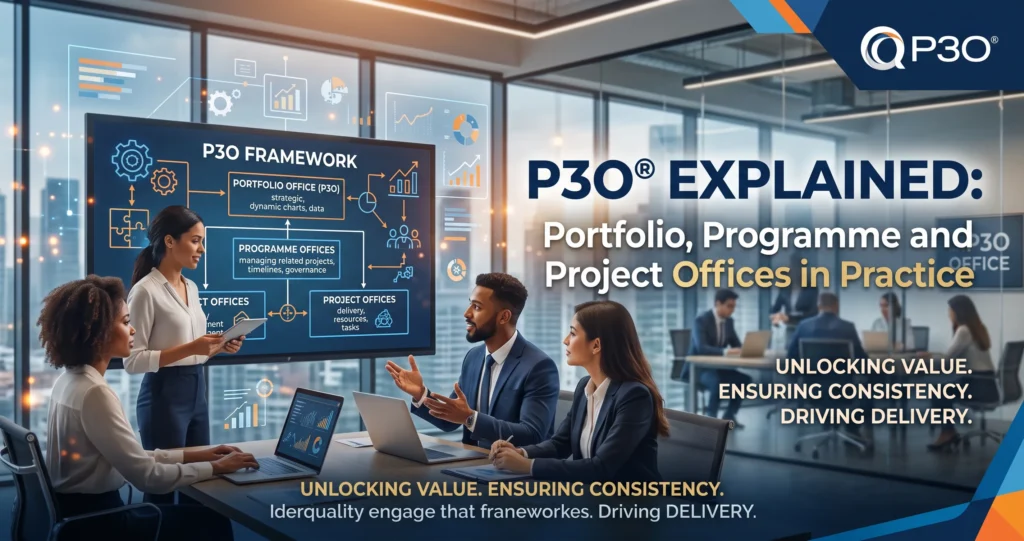
This is where P3O® (Portfolio, Programme and Project Offices) comes in.
P3O provides a proven framework for designing, implementing, and operating governance offices that support successful portfolio, programme, and project management. Rather than focusing only on project delivery, P3O helps organizations create decision-support structures that improve governance, standardization, reporting, and strategic alignment.
At SkillMetrix, professionals learn how P3O can transform organizational delivery capabilities and create measurable business value.
What is P3O?
P3O (Portfolio, Programme and Project Offices) is a globally recognized best practice framework developed to help organizations establish support structures for managing change initiatives.
Instead of treating every project independently, P3O creates an integrated model that enables organizations to:
P3O recognizes that organizations require different support functions depending on whether they are managing portfolios, programmes, or individual projects.
Understanding the Three Levels of P3O
1. Portfolio Office
The Portfolio Office operates at the strategic level.
Its primary objective is to ensure that the organization invests in the right initiatives.
Responsibilities include:
Rather than asking:
“Are projects being delivered correctly?”
The Portfolio Office asks:
“Are we delivering the right projects?”
2. Programme Office
A Programme Office supports large transformational programmes consisting of multiple related projects.
Responsibilities include:
Programme Offices ensure all projects contribute toward achieving broader business outcomes.
3. Project Office
The Project Office operates closest to the delivery teams.
Its responsibilities include:
Project Offices allow project managers to spend more time leading projects and less time handling administration.
Why P3O Matters
Many organizations believe a PMO is enough.
However, as businesses scale, complexity increases dramatically.
Challenges include:
P3O addresses these challenges by providing governance at every organizational level.
Key Objectives of P3O
An effective P3O helps organizations:
Types of P3O Models
One of the strengths of P3O is its flexibility.
Organizations can implement various office structures depending on their size and complexity.
Common models include:
Permanent Office
Supports ongoing governance and continuous business change.
Typically found in large enterprises.
Temporary Office
Established for a specific programme or major transformation.
Closed once objectives are achieved.
Virtual Office
Uses distributed teams instead of centralized staff.
Ideal for global or hybrid organizations.
Hub-and-Spoke Model
A central governance office provides standards while departmental offices support local delivery.
This model is increasingly popular in multinational organizations.
Services Delivered by a P3O
P3O offices typically provide:
Governance Support
Information Management
Resource Management
Financial Management
Assurance
Knowledge Management
Benefits of Implementing P3O
Organizations adopting P3O often experience:
Better Strategic Alignment
Projects directly support organizational goals.
Improved Governance
Clear accountability reduces confusion and duplication.
Increased Delivery Success
Standardized processes improve consistency.
Better Executive Decision-Making
Reliable reporting enables faster, evidence-based decisions.
Greater Resource Optimization
Resources are allocated according to organizational priorities.
Stronger Benefits Realization
Organizations focus not only on delivering outputs but also on achieving measurable business outcomes.
Who Should Learn P3O?
P3O is valuable for:
P3O and Other Best Practice Frameworks
P3O complements several globally recognized frameworks rather than replacing them.
For example:
P3O provides the governance and support structure that enables these frameworks to operate effectively together.
Common Challenges Without P3O
Organizations without structured governance frequently experience:
P3O addresses these issues by introducing standardized governance, clear roles, and effective oversight across portfolios, programmes, and projects.
Why Choose SkillMetrix for P3O Training?
Understanding P3O is one thing—applying it successfully is another.
SkillMetrix helps professionals gain practical knowledge through expert-led training that combines theory with real-world application.
With SkillMetrix, participants benefit from:
Whether you are establishing a new PMO, enhancing an existing governance structure, or advancing your career in project and portfolio management, SkillMetrix provides the expertise and support needed to succeed.
Final Thoughts
Organizations no longer succeed by simply delivering projects on time and within budget. They succeed by selecting the right initiatives, governing them effectively, and ensuring they deliver measurable business value.
P3O offers a structured, scalable framework for creating governance offices that support strategic alignment, consistent delivery, and continual improvement across portfolios, programmes, and projects.
As organizations continue to invest in digital transformation, operational excellence, and enterprise change, professionals with P3O expertise will be increasingly sought after.
If you’re ready to strengthen your governance capabilities or build a high-performing PMO, SkillMetrix can help you develop the practical knowledge and globally recognized skills needed to make a lasting impact.
Ready to build world-class portfolio, programme, and project offices?
Join SkillMetrix and take the next step toward mastering P3O best practices and modern governance frameworks.
